
Rosie’s Second Chance: How a Tiny Cat Helped Make Veterinary History
At just 2kg, Rosie is one of the smallest (adult!) patients we have ever treated.
But her size was only part of what made her case so extraordinary.
For months, this tiny cat lived with a rare and devastating condition called atlantoaxial instability (AAI), a disorder affecting the first two vertebrae of the neck. The condition causes instability between the atlas (C1) and axis (C2) vertebrae, which normally work together to support the head and protect the spinal cord.
In many patients, AAI causes neurological symptoms such as wobbliness, weakness, difficulty walking, or even paralysis. For Rosie, the most obvious symptom was something equally heartbreaking: severe, unrelenting pain.
Her owner remembers hearing her scream.
The only thing that brought relief was a specially fitted neck brace. As long as the brace remained in place, Rosie was comfortable. Without it, the pain would return.
What followed was a journey that crossed continents in search of answers.
A Rescue Cat Who Was Always Special
Rosie’s story began long before her diagnosis.
One evening, a friend who had spent years caring for Dubai’s stray cats discovered three tiny kittens hidden inside the engine of a car that had arrived from another location. The kittens were estimated to be only five days old. Their eyes were still closed.
Rosie’s owners immediately stepped in to help.
“We bottle-fed them every two hours, day and night,” her owner recalls. “They grew stronger every day.”
Eventually, one kitten found a home, while Rosie and her brother became permanent members of the family. They were loved from the very beginning.
During a summer trip to Switzerland, Rosie began showing signs that something wasn’t right. Initially, the pain appeared only occasionally. Her veterinary team investigated thoroughly, determined to find the source.
As the weeks passed, the episodes became more frequent and more severe.
Then, during one particularly painful episode, another full-body radiographic examination revealed the cause. The first cervical vertebra was not positioned correctly.
Rosie had atlantoaxial instability.
From that moment on, she wore a neck bandage continuously to stabilize her neck.
The brace helped, but it was not a solution. It was simply the only thing standing between Rosie and severe pain.
Several veterinary specialists in Switzerland and Dubai reached the same conclusion: surgery was the only realistic long-term treatment option.
Unfortunately, there was a major problem…. the standard surgery Isn’t Possible
Traditional surgical correction of atlantoaxial instability typically involves stabilizing the vertebrae using implants such as screws or pins.
In larger patients, these techniques can be highly successful.
But Rosie was not a typical patient.
Her dwarfism and tiny body size created a unique challenge. The implants normally used to stabilize the joint were simply too large relative to her anatomy. Attempting a traditional fixation carried substantial risks, including catastrophic damage to nearby structures.
Multiple veterinarians agreed that the standard surgical approach was simply too dangerous.
Rosie’s owners were devastated. They knew she could not continue living indefinitely in a neck brace, but no one seemed to have a safe alternative.
Then they discovered another story.
The Cat Who Came Before Her
While searching for answers, Rosie’s owners came across a blog published by German Veterinary Clinic. It told the story of another unusually small cat named Nico. Nico had been diagnosed with the same rare condition.
Like Rosie, he was too small for conventional implant-based surgery.
Faced with this challenge, Clinical Director, Veterinary Neurosurgeon Dr. Sergio Soda pioneered an alternative stabilization procedure using a dorsal suture technique.
While this technique had previously been described in toy-breed dogs, there was no published evidence of it being successfully performed in cats.
Nico became the first.
The outcome was remarkable.
For Rosie’s owners, it represented something they had almost lost: hope.
“We contacted German Veterinary Clinic and went to see Dr. Sergio, which was the best thing we ever did for her,” says Rosie’s owner.
Planning for a Second First
After a detailed consultation and careful assessment of the risks, Dr. Sergio proposed performing the same dorsal suture stabilization procedure for Rosie.
Although Nico’s success gave reason for optimism, every patient is different.
There were no guarantees.
Rosie’s owners understood the risks. But they also understood that continuing as she was meant a lifetime of pain.
The decision was made.
The procedure required extensive planning and collaboration between multiple departments.
Dr. Sergio led the surgery, assisted by Senior Veterinary Nurse Jonathan, who had also been involved in Nico’s groundbreaking procedure. Clinical Manager and Veterinary Nurse Nora Shackelford managed anesthesia with Dr. Helen providing additional anesthetic oversight, while Senior Veterinary Nurse Leo supported the team throughout the process.
Every detail mattered.
For a patient weighing only 2kg, precision was everything.
A Promising Start
The surgery proceeded smoothly.
Post-operative imaging showed that the vertebrae had been successfully repositioned and stabilized. It was exactly what the team had hoped to see.
But surgery was only the beginning.
The next several weeks would determine whether the repair could heal successfully.
Rosie continued wearing her brace, underwent strict cage rest, and followed a carefully structured rehabilitation plan.
Her owner approached every instruction with extraordinary dedication.
There were no shortcuts. No risks taken.
Every recommendation was followed meticulously.
At her first recheck appointment, Dr. Sergio began gradually reducing her dependence on the neck brace. The process was slow and deliberate.
One hour without the brace became two. Two became four.
Activity levels increased cautiously.
Week by week, Rosie continued to improve.
A Cat Without Pain
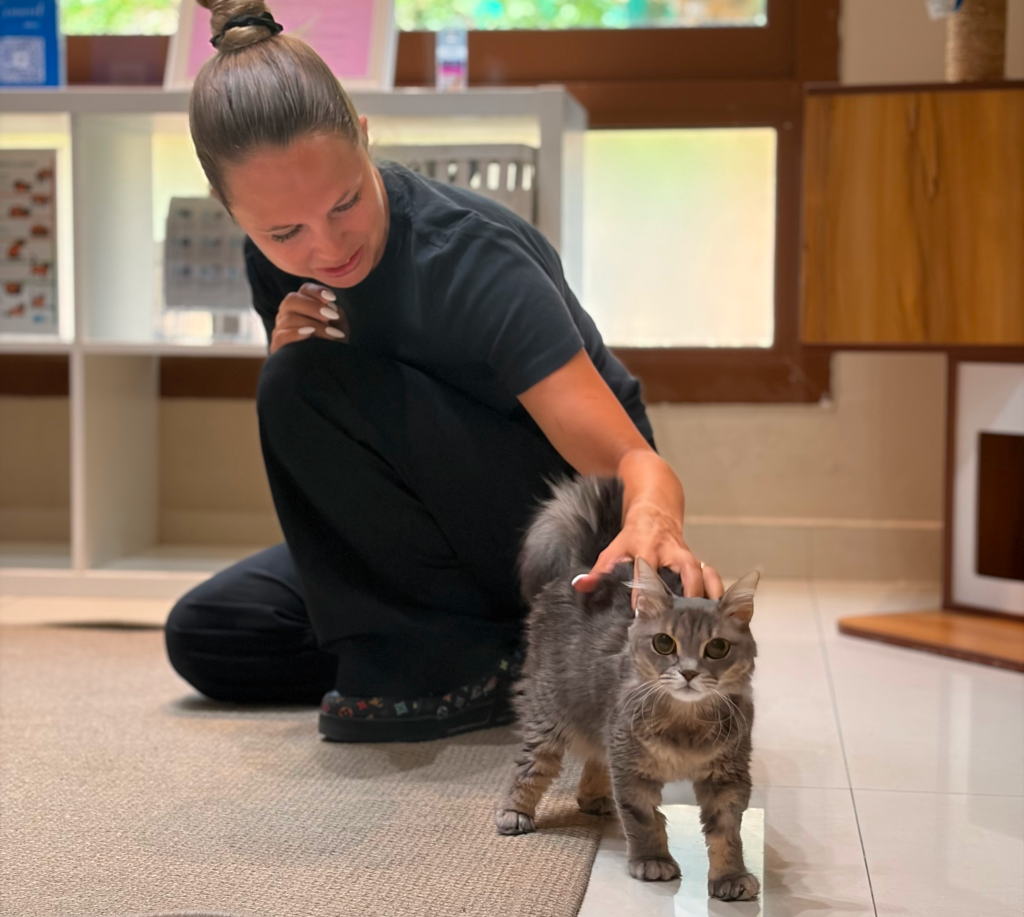
When Rosie returned for her most recent follow-up examination, the transformation was impossible to miss.
Gone was the cat who depended on a neck brace for comfort.
Gone was the cat living in fear of the next painful episode.
Instead, there was a bright, confident, affectionate little cat exploring the consultation room and even jumping onto furniture.
Most importantly, she was pain-free.
According to her owner, Rosie has become more vocal, more cuddly, and happier than ever before.
“It’s like having a completely different cat,” she says. “Now she can live a normal life.”
What Rosie’s Story Means
Cases like Rosie’s are exceptionally rare. They require innovation, collaboration, and owners willing to pursue every possible avenue for their pets.
While the dorsal suture technique is not appropriate for every patient with atlantoaxial instability, Rosie’s success represents another important step forward in expanding treatment options for very small cats who may not be candidates for traditional fixation techniques.
For owners around the world facing a similar diagnosis, her story carries an important message:
A rare condition does not always mean there are no options.
Today, Rosie is no longer defined by pain, a neck brace, or a diagnosis.
She is simply a happy little cat living the life she was always meant to have.
And for everyone involved in her journey, that is the outcome that matters most.