From Paralysis to Walking Again: Rolo’s Neurosurgery Journey at GVC
How specialist veterinary neurosurgery, an incredible family and a lot of determination helped one little Dachshund find her feet again
When Rolo arrived at German Veterinary Clinic a few weeks ago, her owners were facing one of the most frightening situations any pet parent can imagine.
Their beloved little Dachshund could no longer walk.
Rolo had developed severe neurological signs, including paralysis affecting her hind limbs. For her family, the situation was devastating. But one thing was immediately clear: they were not prepared to give up on her.
They were ready to fight for Rolo every step of the way.
And that is where her journey with GVC’s neurology and neurosurgery team began.
A neurological emergency
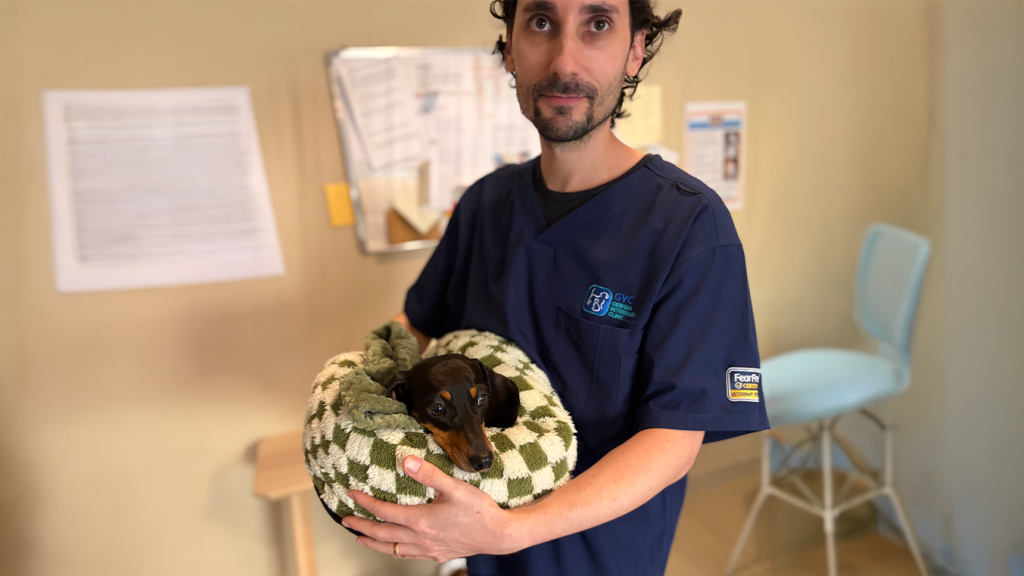
Rolo was assessed by GVC Clinical Director and Veterinary Neurologist and Neurosurgeon, Dr Sergio Soda Zaragoza.
Dr Sergio has a particular focus on complex neurological and neurosurgical cases and leads GVC’s neurology and neurosurgery service, receiving referral cases from across the UAE and internationally.
He holds the European School for Advanced Veterinary Studies (ESAVS) Certificate in Neurology and Neurosurgery and has extensive experience managing both medical and surgical neurological conditions.
A detailed neurological examination was the first step.
When a dog suddenly loses the ability to walk, there can be a number of possible causes. Localising exactly where the problem lies within the nervous system is critical before deciding what diagnostic imaging or treatment is required.
For Rolo, advanced imaging was the next step.
An MRI scan confirmed an intervertebral disc extrusion, with disc material compressing the spinal cord.
Intervertebral disc extrusion, often referred to as IVDE or commonly as “a slipped disc”, is one of the most common causes of acute neurological problems in dogs.
In susceptible breeds such as Dachshunds, degeneration of the intervertebral discs can occur at a relatively young age, and a disc can suddenly rupture or extrude, placing pressure on the spinal cord and causing anything from severe pain and weakness to complete paralysis. For dogs with significant spinal cord compression and neurological deficits, surgical decompression may be recommended to remove the pressure from the spinal cord.
For Rolo, the decision was made.
She would need surgery.
The following day: neurosurgery at GVC
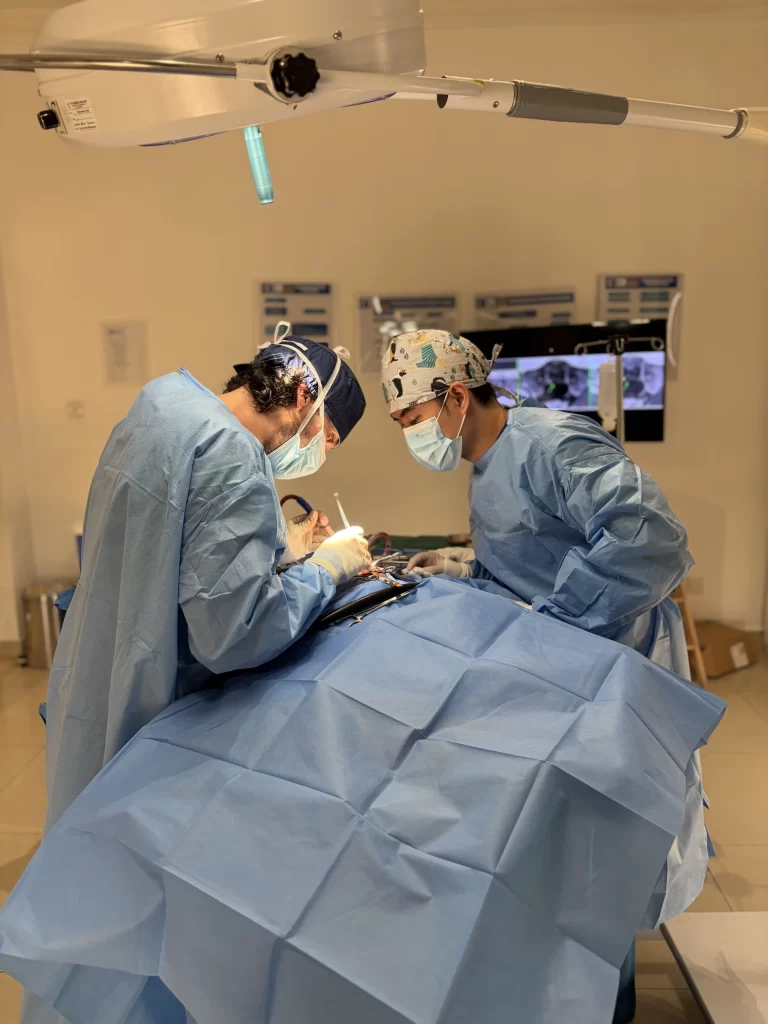
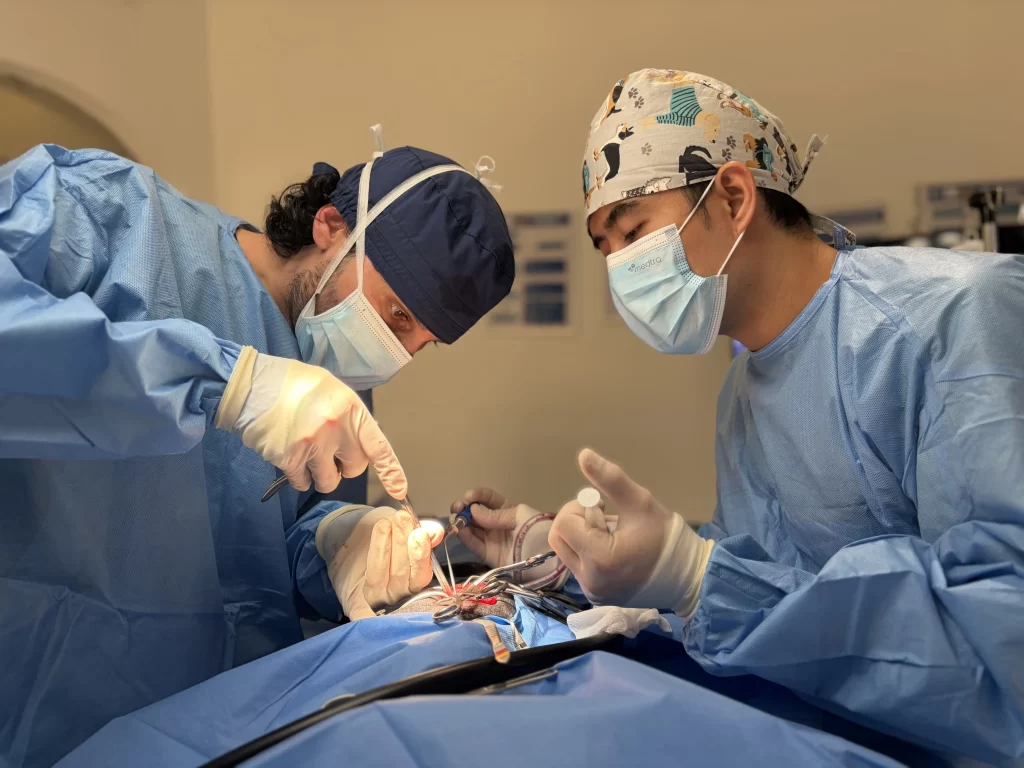
The very next day, Rolo underwent a hemilaminectomy, performed by Dr Sergio.
A hemilaminectomy is a specialised spinal surgery used to access and remove extruded disc material that is compressing the spinal cord.
Rather than approaching the spinal cord directly, the surgeon carefully removes a portion of the vertebral bone from one side of the spine, creating an opening through which the compressed area can be accessed. The aim is to safely remove the material causing the compression and decompress the spinal cord.
Hemilaminectomy or mini-hemilaminectomy is a commonly used surgical approach for thoracolumbar disc extrusion because it provides access to the area where the extruded disc material is compressing the spinal cord.
But a successful neurosurgical procedure is never just about the surgeon.
It takes a team.
For Rolo, that team included Dr Sergio, leading the neurosurgery; Practice Director and Veterinary Nurse Nora, who managed her anaesthesia; Head Nurse Jonathan; and Senior Nurse Leo.
Every member of the team had a specific role to play in keeping Rolo safe, comfortable and carefully monitored throughout the procedure.
The surgery went extremely well.
But everyone knew that the surgery itself was only the beginning.
The long road back
One of the hardest things for owners to understand after spinal surgery is that neurological recovery is rarely an overnight transformation.
The spinal cord needs time to recover.
Depending on the severity and location of the injury, dogs can take weeks or sometimes considerably longer to regain strength, coordination and normal neurological function. Post-operative rehabilitation and carefully controlled activity form an important part of the recovery process. Veterinary consensus guidance supports beginning appropriate rehabilitation early, while maintaining strict activity restriction to allow the surgical site and spine to heal.
So Rolo’s recovery was taken one small step at a time.
And her owners were extraordinary.
Open Concept Care: keeping Rolo close
Rolo’s family fully embraced GVC’s Open Concept Care approach.
Rather than feeling separated from their beloved dog during her recovery, they were able to spend time with her, remain involved in her care and even work from the clinic while she recovered.
For a patient recovering from major spinal surgery, having familiar people close by can make a huge difference to the experience.
And for owners, being able to see those little changes for themselves can be incredibly reassuring.
A movement of the leg.
A change in posture.
A little more strength.
A slightly more purposeful movement.
With neurological patients, these tiny moments matter.
Physiotherapy from the very beginning
Rolo’s owners were also incredibly diligent with her rehabilitation.
We brought in Sarah, an experienced veterinary physiotherapist, who worked with Rolo and her family to get her rehabilitation programme started.
Physiotherapy and controlled rehabilitation can be incorporated into recovery following spinal surgery, with exercises tailored to the individual patient’s neurological status and stage of healing.
Rolo’s family followed the programme with incredible dedication.
And then came the moment everyone had been waiting for.
Two weeks later…
Rolo walked.
Not perfectly.
Not normally.
Not yet.
But she was walking.
For a little dog who had arrived unable to use her hind limbs, seeing those first steps just two weeks after such a serious neurological event was an extraordinary moment for everyone who had been involved in her care.
Rolo still had a road ahead of her, and neurological recovery should never be rushed. Her continued rehabilitation, controlled exercise and follow-up care remain important parts of her journey.
But those first steps were a very special milestone.
When specialist care and a determined family come together
Rolo’s story is a wonderful example of what can happen when specialist veterinary neurology, advanced diagnostics, neurosurgery, nursing care, rehabilitation and an incredibly committed family all come together.
From the initial neurological consultation and MRI, through surgery and anaesthesia, to the long hours of nursing care and physiotherapy that followed, Rolo had an entire team behind her.
But she also had something just as important.
A family who never gave up on her.
At German Veterinary Clinic, we know that advanced veterinary medicine is about far more than performing a procedure.
It is about understanding the patient.
It is about supporting the people who love them.
It is about creating an environment where pets can recover with their families close by.
And it is about celebrating every little victory along the way.
For Rolo, one of those victories came just two weeks after surgery.
A little Dachshund who had arrived unable to walk was back on her feet.
And we couldn’t have been happier to see her take those first steps.
Veterinary Neurology & Neurosurgery in Abu Dhabi
German Veterinary Clinic provides specialist veterinary neurology and neurosurgery for dogs and cats, including neurological examinations, advanced diagnostic imaging and surgical treatment of complex spinal and brain conditions.
Our neurology and neurosurgery service is led by Dr Sergio Soda Zaragoza, Veterinary Neurologist and Neurosurgeon and GVC Clinical Director.
If your dog develops sudden weakness, difficulty walking, severe back pain, loss of coordination or paralysis, prompt veterinary assessment is important. Early neurological evaluation can help determine the cause and identify the most appropriate diagnostic and treatment options for your pet.
German Veterinary Clinic — advanced veterinary care, with your family beside you.